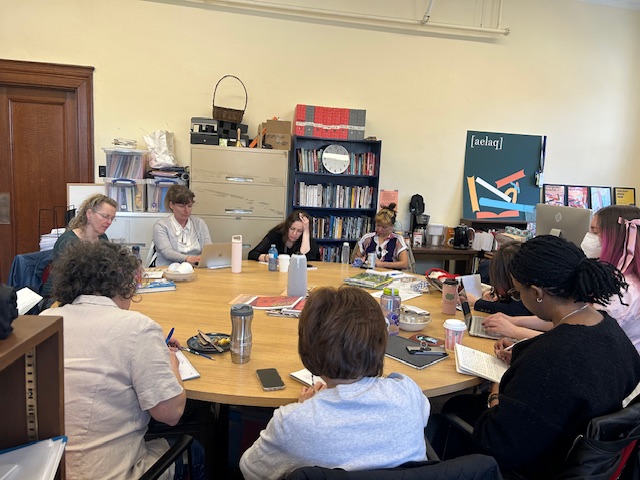
On Saturday, April 18, 2026, I attended a lovely picture book workshop led by children’s author Monique Polak. It was held at the QWF office with a small group of participants.
The full-day session (10:30 a.m. to 4:30 p.m.) focused on reading and deconstructing picture books to better understand the fundamentals of the genre.
We explored what types of stories are best suited to picture books, the conventions of the format, common themes, and the role of language. And we covered the following books:
- Pierre by Maurice Sendak
- When We Were Alone by David A. Robertson
- Knuffle Bunny by Mo Willems
- The Funeral by Matt James
- Proud as a Peacock, Brave as a Lion by Jane Barclay
- I’m Glad That You’re Happy by Nahid Kazemi
In addition to the readings, we completed guided writing exercises, including one that invited us to recall childhood memories through our five senses.
There was also time to present our picture book projects in progress and receive group feedback.
My Key Takeaways
Core storytelling principles
- Picture books are centred on a child protagonist
- The child must experience growth or change—even a small shift can be meaningful
- The resolution should come from the child, not the adult
- A story doesn’t need a happy ending, but it must show emotional development
- Strong stories include challenge or conflict, which gives the narrative meaning
Character development
- Use contrasts and opposites (foils) to create dynamic characters
- Avoid making characters too similar—differences make stories more engaging and relatable
Themes and scope
- Serious topics, including death, are appropriate for children’s literature when handled thoughtfully
- Picture books can address complex emotions and ideas in accessible ways
- They are written for both children and adults, so they should resonate on multiple levels
Structure and writing techniques
- Keep stories concise: ~900 words max, ideally closer to 600 (illustration notes excluded)
- Start in the action to quickly engage the reader
- Use the Rule of 3: build tension through three escalating events, resolving on the third
- Incorporate repetition, as picture books are meant to be read aloud and invite participation
- Focus on specific details, but avoid overload—leave room for illustrations
- Use simple, poetic language (e.g., clear similes, implied meaning rather than explicit statements)
- Cut unnecessary dialogue—keep only what moves the story forward
Creative approach
- Draw from memory, dreams, and sensory details
- Expand ideas with “what if” scenarios to add imagination and depth
- “Write small to go big”: focus on intimate, specific moments that create broader emotional impact
Practical insights
- Read your work aloud repeatedly to refine rhythm and flow
- Humor is valuable—some editors actively look for it
- Research topics thoroughly when writing nonfiction or fact-based stories
- Picture book nonfiction (e.g., biographies) is a strong category if presented in an engaging, accessible way
- The market varies: middle grade is strong (e.g., Milo by Alan Silberberg), while YA is more competitive
- Editing support can help refine manuscripts
Hope this is helpful.
I highly recommend this workshop if you’re starting out with picture book writing.


Leave a Reply