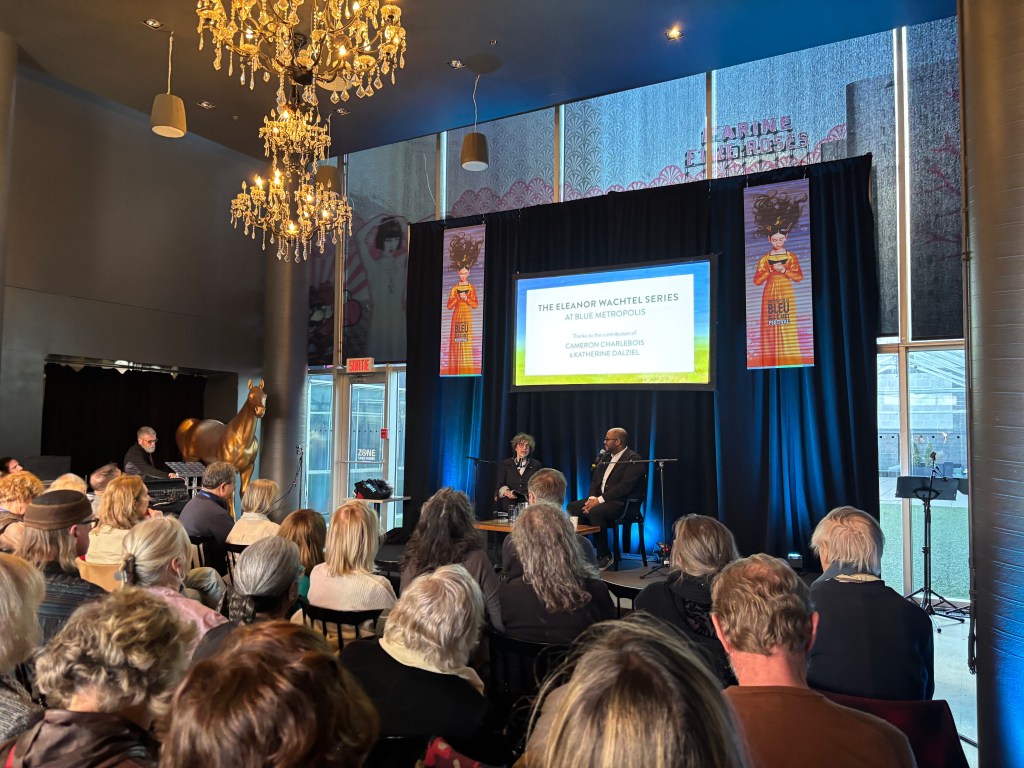
Reflections from the 2026 Blue Metropolis Literary Festival
There are festivals you go to hear stories, and there are festivals where you begin to question the act of storytelling itself.
My time at the 2026 Blue Metropolis International Literary Festival felt like the latter: a gathering not just of writers, but of people wrestling with language and what it means to be fully alive in a fractured world.
The 28th edition of the festival, which occurred from April 23 to 26, 2026, focused on the theme “Words for Understanding One Another.”
Held at Hotel 10, the multilingual event highlighted literature as a tool for connection and subversion in a world filled with conflict and noise.
Waking up with Anxiety
One of the most arresting voices was Iranian-American author, Azar Nafisi, who challenged the romantic notion that passion fuels our days.
“We don’t wake up with passion,” she said. “We wake up with anxiety.”
It landed heavily in the room. Anxiety, not inspiration, is our common inheritance.
And yet, she insisted, that’s precisely why we must fight harder for feeling, for empathy.
In a time that often rewards detachment, she argued that reclaiming our emotional depth is an act of resistance.
To be “on the side of life” is not passive; it requires attention, courage, and a refusal to numb ourselves.
Perhaps most haunting was her call for “conclusive evidence that we have lived,” a reminder that existence alone is not the same as presence.
The World as a Domestic Situation
Antiguan–American novelist, Jamaica Kincaid, grounded us in something both more intimate and more expansive.
“Planet Earth is indifferent to us,” she said plainly. Not cruel, just indifferent.
And yet, we belong to it. We are “of the earth,” entangled in its systems whether we acknowledge it or not.
Kincaid reframed the world as a “domestic situation,” collapsing the distance between the global and the personal.
Her garden, she explained, is not just a garden. It is a text, a living narrative.
“My garden is a book.”
It made me think about care: how tending to something, whether soil or sentence, becomes a way of making meaning in an indifferent universe.
Words Under Attack
If Nafisi and Kincaid spoke to feeling and belonging, Ukrainian poet, Lyuba Yakimchuk, exposed the fragility of the very medium they use: language itself.
Broadening our Perspective
English writer and savant, Daniel Tammet, offered a different perspective rooted in his experience as a person with autism.
“On peut communiquer à travers les échecs” (we can communicate through failures).
It’s a quiet but radical idea: that connection doesn’t require perfection, only openness.
Tammet spoke about pain as something “au-delà du langage” (beyond language) and yet, he has built a life around “raconter le langage autrement,” telling language differently.
His reflections on autism as an “invisible condition” opened up a broader question: how many ways of seeing the world go unrecognized simply because they don’t conform to dominant narratives?
To see differently, he suggested, is not a deficit, it’s another form of insight.
A Shared Urgency
What tied all these voices together was a shared urgency.
Whether speaking about empathy, ecology, war, or neurodiversity, each writer circled the same core truth: language shapes reality, but it is also shaped by how we choose to live.
I left the festival with a strange but steady clarity. We may wake up with anxiety, as Nafisi says, but we don’t have to end the day there.
We can choose to feel more, to notice more; to question the words handed to us.
We can tend our gardens (literal or metaphorical) with care. We can remain alert to the ways language is used to distort, and insist on reclaiming it.
If there is such a thing as “conclusive evidence that we have lived,” perhaps it lies here: in our willingness to engage deeply. With words, with the world, with each other.


Leave a comment